
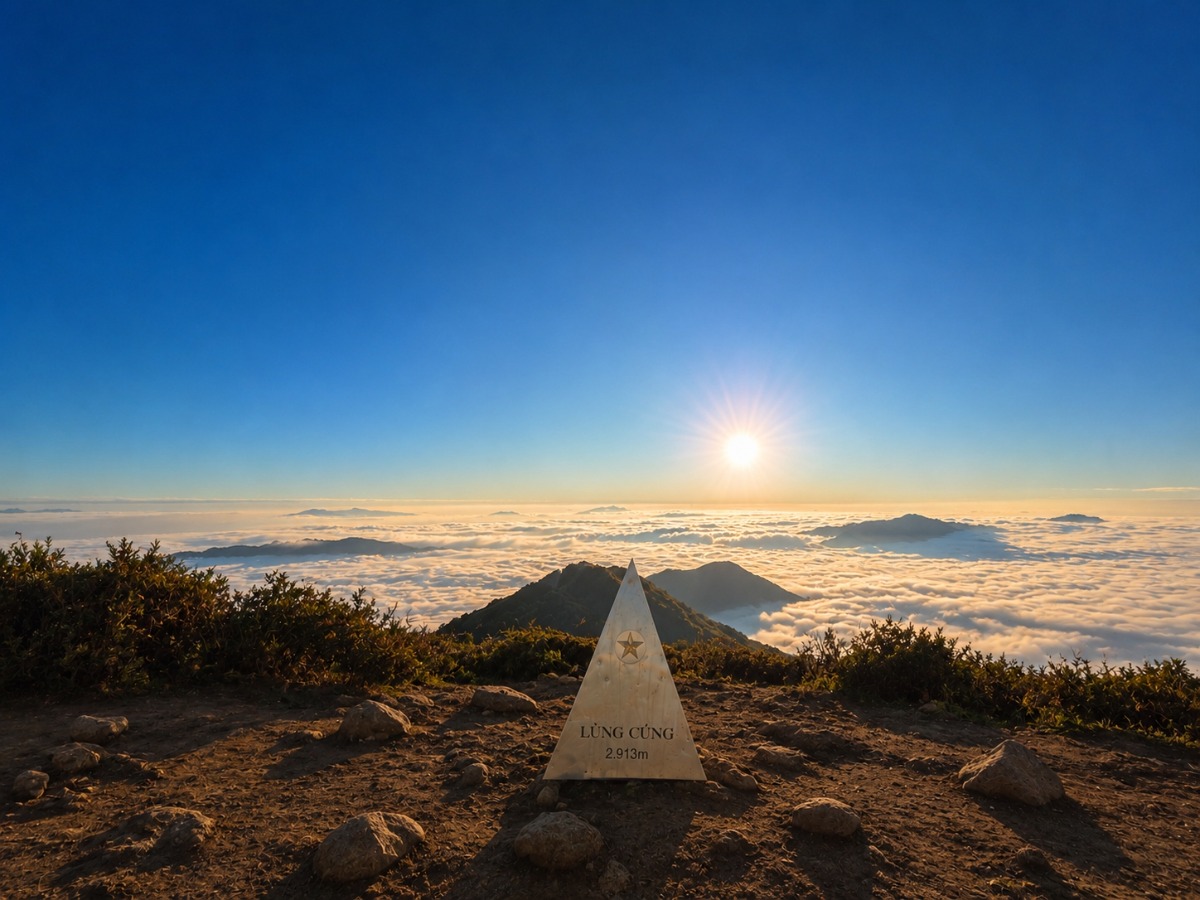
Lung Cung Peak
Last update: 18/09/2026
Address: bản Lùng Cúng, Xã Nậm Có, Lào Cai
Old address: xã Nậm Có, huyện Mù Cang Chải, tỉnh Yên Bái
Lung Cung Peak is one of the highest and most beautiful mountains in Vietnam, reaching an altitude of 2,913 meters, and is known as the "roof" of Mu Cang Chai district, Yen Bai province. The mountain's name comes from a Thai ethnic village located deep within the rugged mountains of Nam Co commune. It's an ideal destination for those who love trekking, cloud hunting, and exploring the pristine nature of the Northwest region.
Lung Cung has a moderate difficulty level and a short climbing distance (about 15 km round trip), making it suitable for beginners. There are three main approaches starting from three villages: Lung Cung village, Thao Chua Chai village, and Tu San village. Tourists often choose a 2-day, 1-night itinerary:
- Day 1: Travel from Hanoi to Tu Le, take a motorbike taxi to the foot of the mountain, and trek for about 5 hours through the primeval forest to reach the rest stop.
- Day 2: Wake up early to watch the sunrise, then hike for about an hour through the bamboo forest to reach the summit at 2,913m, before descending and returning.
The journey to conquer Lung Cung Peak offers a unique experience thanks to its diverse ecosystem and vegetation that changes with altitude:
- Primary forest: Ancient chestnut trees hundreds of years old are covered in moss.
- Nam Co Bamboo Forest: A path winding through lush, straight bamboo groves, like something out of a martial arts film.
- Ta Co Y Grassland: A vast, windy grassland offering expansive views before reaching the summit.
- 360-degree Sea of Clouds: The mountaintop is a wide, flat area, allowing visitors to fully admire both sunrise and sunset amidst a sea of fluffy clouds.
Ideal time to explore:
- January – March: Warm spring, clear blue skies, this is the time when peach and plum blossoms bloom throughout the mountains and forests.
- September – October: The rice fields of Mu Cang Chai turn a brilliant golden color when ripe. The air is filled with the fragrant scent of ripe wild apples.
- November – December: The Ta Co Y valley transforms with charming slopes of yellow and purple wildflowers.
Note: It is advisable to avoid visiting from May to August as this is the rainy season, the roads are slippery and muddy, and dangerous landslides are very likely to occur.

Copyright ©2026 VietExplore. All rights reserved.